
When we see that children everywhere are required by law to go to school, that almost all schools are structured in the same way, and that our society goes to a great deal of trouble and expense to provide such schools, we tend naturally to assume that there must be some good, logical reason for all this. Perhaps if we didn't force children to go to school, or if schools operated much differently, children would not grow up to be competent adults. Perhaps some really smart people have figured all this out and have proven it in some way, or perhaps alternative ways of thinking about child development and education have been tested and have failed.
In previous postings, I have presented evidence to the contrary. In particular, in my August 13 posting, I described the Sudbury Valley School, where for 40 years children have been educating themselves in a setting that operates on assumptions that are opposite to those of traditional schooling. Studies of the school and its graduates show that normal, average children become educated through their own play and exploration, without adult direction or prodding, and go on to be fulfilled, effective adults in the larger culture. Instead of providing direction and prodding, the school provides a rich setting within which to play, explore, and experience democracy first hand; and it does that at lower expense and with less trouble for all involved than is required to operate standard schools. So why aren't most schools like that?If we want to understand why standard schools are what they are, we have to abandon the idea that they are products of logical necessity or scientific insight. They are, instead, products of history. Schooling, as it exists today, only makes sense if we view it from a historical perspective. And so, as a first step toward explaining why schools are what they are, I present here, in a nutshell, an outline of the history of education, from the beginning of humankind until now. Most scholars of educational history would use different terms than I use here, but I doubt that they would deny the overall accuracy of the sketch. In fact, I have used the writings of such scholars to help me develop the sketch.
In the beginning, for hundreds of thousands of years, children educated themselves through self-directed play and exploration.
In relation to the biological history of our species, schools are very recent institutions. For hundreds of thousands of years, before the advent of agriculture, we lived as hunter-gatherers. In my August 2 posting, I summarized the evidence from anthropology that children in hunter-gatherer cultures learned what they needed to know to become effective adults through their own play and exploration. The strong drives in children to play and explore presumably came about, during our evolution as hunter-gatherers, to serve the needs of education. Adults in hunter-gatherer cultures allowed children almost unlimited freedom to play and explore on their own because they recognized that those activities are children's natural ways of learning.
With the rise of agriculture, and later of industry, children became forced laborers. Play and exploration were suppressed. Willfulness, which had been a virtue, became a vice that had to be beaten out of children.
The invention of agriculture, beginning 10,000 years ago in some parts of the world and later in other parts, set in motion a whirlwind of change in people's ways of living. The hunter-gatherer way of life had been skill-intensive and knowledge-intensive, but not labor-intensive. To be effective hunters and gatherers, people had to acquire a vast knowledge of the plants and animals on which they depended and of the landscapes within which they foraged. They also had to develop great skill in crafting and using the tools of hunting and gathering. They had to be able to take initiative and be creative in finding foods and tracking game. However, they did not have to work long hours; and the work they did was exciting, not dreary. Anthropologists have reported that the hunter-gatherer groups they studied did not distinguish between work and play--essentially all of life was understood as play.
Agriculture gradually changed all that. With agriculture, people could produce more food, which allowed them to have more children. Agriculture also allowed people (or forced people) to live in permanent dwellings, where their crops were planted, rather than live a nomadic life, and this, in turn, allowed people to accumulate property. But these changes occurred at a great cost in labor. While hunter-gatherers skillfully harvested what nature had grown, farmers had to plow, plant, cultivate, tend their flocks, and so on. Successful farming required long hours of relatively unskilled, repetitive labor, much of which could be done by children. With larger families, children had to work in the fields to help feed their younger siblings, or they had to work at home to help care for those siblings. Children's lives changed gradually from the free pursuit of their own interests to increasingly more time spent at work that was required to serve the rest of the family.
Agriculture and the associated ownership of land and accumulation of property also created, for the first time in history, clear status differences. People who did not own land became dependent on those who did. Also, landowners discovered that they could increase their own wealth by getting other people to work for them. Systems of slavery and other forms of servitude developed. Those with wealth could become even wealthier with the help of others who depended on them for survival. All this culminated with feudalism in the Middle Ages, when society became steeply hierarchical, with a few kings and lords at the top and masses of slaves and serfs at the bottom. Now a lot of most people, children included, were servitude. The principal lessons that children had to learn were obedience, suppression of their own will, and the show of reverence toward lords and masters. A rebellious spirit could well result in death.
In the Middle Ages, lords and masters had no qualms about physically beating children into submission. For example, in one document from the late 14th or early 15th century, a French count advised that nobles' huntsmen should "choose a boy servant as young as seven or eight" and that "...this boy should be beaten until he has a proper dread of failing to carry out his masters orders."[1] The document went on to list a prodigious number of chores that the boy would perform daily and noted that he would sleep in a loft above the hounds at night in order to attend to the dogs' needs.
With the rise of industry and of a new bourgeoisie class, feudalism gradually subsided, but this did not immediately improve the lives of most children. Business owners, like landowners, needed laborers and could profit by extracting as much work from them as possible with as little compensation as possible. Everyone knows of the exploitation that followed and still exists in many parts of the world. People, including young children, worked most of their waking hours, seven days a week, in beastly conditions, just to survive. The labor of children was moved from fields, where there had at least been sunshine, fresh air, and some opportunities to play, into dark, crowded, dirty factories. In England, overseers of the poor commonly farmed out paupers' children to factories, where they were treated as slaves. Many thousand of them died each year of diseases, starvation, and exhaustion. Not until the 19th century did England pass laws limiting child labor. In 1883, for example, new legislation forbade textile manufacturers from employing children under the age of 9 and limited the maximum weekly work hours to 48 for 10- to 12-year-olds and to 69 for 13- to 17-year-olds [2].
In sum, for several thousand years after the advent of agriculture, the education of children was, to a considerable degree, a matter of squashing their willfulness in order to make them good laborers. A good child was an obedient child, who suppressed his or her urge to play and explore and dutifully carried out the orders of adult masters. Such education, fortunately, was never fully successful. The human instincts to play and explore are so powerful that they can never be fully beaten out of a child. But certainly, the philosophy of education throughout that period, to the degree that it could be articulated, was the opposite of the philosophy that hunter-gatherers had held for hundreds of thousands of years earlier.
For various reasons, some religious and some secular, the idea of universal, compulsory education arose and gradually spread. Education was understood as inculcation.
As the industry progressed and became somewhat more automated, the need for child labor declined in some parts of the world. The idea began to spread that childhood should be a time for learning, and schools for children were developed as places of learning. The idea and practice of universal, compulsory public education developed gradually in Europe, from the early 16th century to the 19th. It was an idea that had many supporters, who all had their own agendas concerning the lessons that children should learn.
Much of the impetus for universal education came from the emerging Protestant religions. Martin Luther declared that salvation depends on each person's own reading of the Scriptures. A corollary, not lost on Luther, was that each person must learn to read and must also learn that the Scriptures represent absolute truths and that salvation depends on understanding those truths. Luther and other leaders of the Reformation promoted public education as Christian duty, to save souls from eternal damnation. By the end of the 17th century, Germany, which was the leader in the development of schooling, had laws in most of its states requiring that children attend school; but the Lutheran church, not the state, ran the schools [3].
In America, in the mid 17th century, Massachusetts became the first colony to mandate schooling, the clearly stated purpose of which was to turn children into good Puritans. Beginning in 1690, children in Massachusetts and adjacent colonies learned to read from the New England Primer, known colloquially as "The Little Bible of New England" [4]. It included a set of short rhymes to help children learn the alphabet, beginning with, "In Adam's Fall, We sinned all," and ending with, "Zaccheus he, Did climb the tree, His Lord to see." The Primer also included the Lord's Prayer, the Creed, the Ten Commandments, and various lessons designed to instill in children a fear of God and a sense of duty to their elders.
Employers in the industry saw schooling as a way to create better workers. To them, the most crucial lessons were punctuality, following directions, tolerance for long hours of tedious work, and a minimal ability to read and write. From their point of view (though they may not have put it this way), the duller the subjects taught in schools the better.
As nations gelled and became more centralized, national leaders saw schooling as a means of creating good patriots and future soldiers. To them, the crucial lessons were about the glories of the fatherland, the wondrous achievements and moral virtues of the nation's founders and leaders, and the necessity to defend the nation from evil forces elsewhere.
Into this mix, we must add reformers who truly cared about children, whose messages may ring sympathetically in our ears today. These are people who saw schools as places for protecting children from the damaging forces of the outside world and for providing children with the moral and intellectual grounding needed to develop into upstanding, competent adults. But they too had their agenda for what children should learn. Children should learn moral lessons and disciplines, such as Latin and mathematics, that would exercise their minds and turn them into scholars.
So, everyone involved in the founding and support of schools had a clear view of what lessons children should learn in school. Quite correctly, nobody believed that children left to their own devices, even in a rich setting for learning, would all learn just exactly the lessons that they (the adults) deemed to be so important. All of them saw schooling as inculcation, the implanting of certain truths and ways of thinking into children's minds. The only known method of inculcation, then as well as now, is forced repetition and testing for a memory of what was repeated.
With the rise of schooling, people began to think of learning as children's work. The same power-assertive methods that had been used to make children work in fields and factories were quite naturally transferred to the classroom.
Repetition and memorization of lessons is tedious work for children, whose instincts urge them constantly to play freely and explore the world on their own. Just as children did not adapt readily to laboring in fields and factories, they did not adapt readily to schooling. This was no surprise to the adults involved. By this point in history, the idea that children's own willfulness had any value was pretty well forgotten. Everyone assumed that to make children learn in school the children's willfulness would have to be beaten out of them. Punishments of all sorts were understood as intrinsic to the educational process. In some schools children were permitted certain periods of play (recess), to allow them to let off steam; but play was not considered to be a vehicle of learning. In the classroom, the play was the enemy of learning.
A prominent attitude of eighteenth-century school authorities toward play is reflected in John Wesley's rules for Wesleyan schools, which included the statement: "As we have no play days, so neither do we allow any time for play on any day; for he that plays as a child will play as a man."[5]
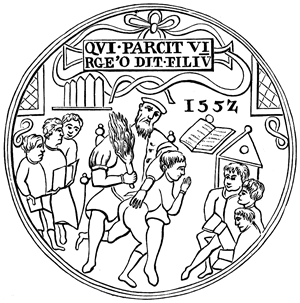
The brute force methods long used to keep children on the task on the farm or in the factory were transported into schools to make children learn. Some of the underpaid, ill-prepared schoolmasters were clearly sadistic. One master in Germany kept records of the punishments he meted out in 51 years of teaching, a partial list of which included: "911,527 blows with a rod, 124,010 blows with a cane, 20,989 taps with a ruler, 136,715 blows with the hand, 10,235 blows to the mouth, 7,905 boxes on the ear, and 1,118,800 blows on the head"[6]. Clearly, that master was proud of all the educating he had done.
In his autobiography, John Bernard, a prominent eighteenth-century Massachusetts minister, described approvingly how he himself, as a child, was beaten regularly by his schoolmaster [7]. He was beaten because of his irresistible drive to play; he was beaten when he failed to learn; he was even beaten when his classmates failed to learn. Because he was a bright boy, he was put in charge of helping others learn, and when they failed to recite a lesson properly he was beaten for that. His only complaint was that one classmate deliberately flubbed his lessons in order to see him beaten. He solved that problem, finally, by giving the classmate "a good drubbing" when the school day was over and threatening more drubbings in the future. Those were the good old days.
In recent times, the methods of schooling have become less harsh, but basic assumptions have not changed. Learning continues to be defined as children's work, and power assertive means are used to make children do that work.
In the 19th and 20th centuries, public schooling gradually evolved toward what we all recognize today as conventional schooling. The methods of discipline became more humane, or at least less corporal; the lessons became more secular; the curriculum expanded, as knowledge expanded, to include an ever-growing list of subjects; and the number of hours, days, and years of compulsory schooling increased continuously. School gradually replaced fieldwork, factory work, and domestic chores as the child's primary job. Just as adults put in their 8-hour day at their place of employment, children today put in their 6-hour day at school, plus another hour or more of homework, and often more hours of lessons outside of school. Over time, children's lives have become increasingly defined and structured by the school curriculum. Children now are almost universally identified by their grade in school, much as adults are identified by their job or career.
Schools today are much less harsh than they were, but certain premises about the nature of learning remain unchanged: Learning is hard work; it is something that children must be forced to do, not something that will happen naturally through children's self-chosen activities. The specific lessons that children must learn are determined by professional educators, not by children, so education today is still, as much as ever, a matter of inculcation (though educators tend to avoid that term and use, falsely, terms like "discovery").
Clever educators today might use "play" as a tool to get children to enjoy some of their lessons, and children might be allowed some free playtime at recess (though even this is decreasing in very recent times), but children's own play is certainly understood as inadequate as a foundation for education. Children whose drive to play is so strong that they can't sit still for lessons are no longer beaten; instead, they are medicated.
School today is the place where all children learn the distinction that hunter-gatherers never knew--the distinction between work and play. The teacher says, "you must do your work and then you can play." Clearly, according to this message, work, which encompasses all of the school learning, is something that one does not want to do but must; and play, which is everything that one wants to do, has relatively little value. That, perhaps, is the leading lesson of our method of schooling. If children learn nothing else in school, they learn the difference between work and play and that learning is work, not play.
In this posting, I have tried to explain how the history of humanity has led to the development of schools as we know them today. In my next posting, I will discuss some reasons why modern attempts to reform schools in basic ways have been so ineffective.

